Thursday, 24 April 2014
My Finished Thriller - Animus
This is the final cut of my thriller opening, Animus.
Hope you enjoy it!

Friday, 4 April 2014
Evaluation Question 7 - "Looking back at the Preliminary task, what do you think you have learned in the process from it?"
Preliminary Task vs. Final Cut
I have learnt so many
techniques in order to better the quality of videos, knowing how different
factors such as camera handling, locations used, usage of sound and mise en
scene and a good storyline can effect the outcome of a media text.
Camera Handling
The camera handling was
good in both the preliminary and the final cut as we used a tripod to steady
the camera while taking shots although as we rushed through the filming during
the preliminary task, not taking time to take more takes of each shot; some of
the shots appear uneven with some tilting diagonally when compared to the final
cut. Most of the shots used in the
preliminary task were simple shot/reverse shots and didn’t give much of a drive
to the storyline.
Also, the amount of
camera angle shots used in the preliminary task was very limited, over the course
I started to realise how using camera angles can enhance the effective of the
shot and started to use them more in subsequent clips.
Location
I also realised that
thrillers often use multiple urban locations to enhance the storyline by
creating this real idea of chase through these multiple locations. Not knowing
where the protagonist next in this adventure, give viewers a sense of tension
and suspense throughout the film.
 |
| We used multiple urban location to enhance this idea of a chance between the protagonist and antagonist |
 |
| We only restricted ourselves to using one location for our preliminary. |
We made sure when
filming the final cut that this would happen as in the preliminary we only
focused the action at one location which made it hard to keep up the tension
and suspense thrillers are known for.
Sound
During the course, I
also learnt how diegetic and non-diegetic sounds could be used to force certain
emotions out of the viewers when watching certain scenes. In our preliminary
task, there was only one piece of non-diegetic music but this is barely
noticeable whereas there are several pieces of non-diegetic music to stimulate
the crowd.
Mise En Scene
We also learnt that
using mise en scene is also a good way of getting viewers to identify the
characters within the film. The costumes, make-up and props used within the
media text can be vital in gripping viewers into watching our opening.
In the preliminary, we
didn’t not really focus on that much on these things and that affected the
storyline drastically as it was really hard to realise who was who in the
storyline. Like the police officer
is hardly wearing clothes that suggest he is a character of power and
importance.
 |
| The protagonist looks more relatable |
 |
| This character hardly looks like a policeman, does he? |
But, in the final cut,
we focused more on this making each character wear certain costumes to make it
easier to identify factors such as the character’s status, class and power. For example the protagonist is the
typical ‘everyman’, causally dressing whereas the antagonists are dressed in
formal attire, suggesting their serious and smart nature over the protagonist.
Story-line
The story-line used in
the preliminary task was good at first but was poorly executed. After watching
and researching several thrillers, I learnt bout several conventions that make
thrillers so famous such as the usage of macguffins and enigma codes, in the
final cut; I made sure that these conventions were implemented into it.
Thursday, 3 April 2014
Wednesday, 2 April 2014
Tuesday, 1 April 2014
Evaluation Question 1 - "In what ways does your media product use, develop or challenge forms and conventions of real media products?"
In my thriller opening, we have used, develop and challenged
the forms and conventions that have been seen in so many thrillers.
In my opening sequence, many techniques such as the usage of a macguffin, suspense, a cliff hanger and the creation of an enigma code helped create the experience that differentiates thrillers from other genres.
The Macguffin
the forms and conventions that have been seen in so many thrillers.
In my opening sequence, many techniques such as the usage of a macguffin, suspense, a cliff hanger and the creation of an enigma code helped create the experience that differentiates thrillers from other genres.
The Macguffin

The usage of a macguffin, in this case a letter, helped to provide a drive to the story line and set up the plot as characters want to know the contents of the letter but are not shown.
It helps in connecting the characters together as all they have one thing to do with this mysterious letter.
It helps in connecting the characters together as all they have one thing to do with this mysterious letter.
There are many thrillers which use macguffins as maintaing the storyline but in reality have little or no narrative explantion.
For example in Casablanca (1942), the letters of transit are used as a macguffin as it is the major object that the protagonist pursues and provides a story line to see how he obtains it.
 |
| The Letters of Transit from Casablanca (1942) The Usage of Enigma Codes |
An enigma is a question, character or action, which is thrown into the thriller to make audiences think and answer why it was done.
It is usually hard to explain or answer at first but gradually the answer is revealed throughtout the thriller.
It is usually hard to explain or answer at first but gradually the answer is revealed throughtout the thriller.
Actions such as the passing of the letter to the protagonist and the bounding of him also create this enigma as questions are raised as to why these actions have occured and only the film will help answer these questions.


The Filming of Scenes in Black and White and The Usage of Low Key Lighting
The filming of scenes in black and white creates the effect of a flashblack, creating sense of time and space disorentation, a dive into a character's past could explain why he's in that particular situation.
The usage of low key lighting, especially on the antagonist, show his dark and evil side.
It makes the antagonist more feared by the viewer as you won't be able to see him; not knowing his real intentions and goals also adds to the mystery of the character.
 |
| Norman Bates of Alfred Hitchcock's Psycho is often potrayed has low key lighting to show his dark and evil side. |
Just like Norman Bates, The Boss also has low key lighing portrayed on him to show his dark and evil side. |
The quest set for the protagonist is usually one that is forced upon him, he can not back out of it
The events that the protagonist find themselves in are often caused by external forces out of their control and put into situations that will find hard to back out of.
They often have to solve the issue at hand or kill the protagonist in order to get of the situation.
 |
| A good example of this is in the film North by Northwest where Roger Thornhill is put into a situation out of his control and the only way to get out of the events is to solve it. |
The Use of a Cliffhanger
This means that the future for charcters after the events in the story is unresolved or certain;this leaves the audience eager to know what will happen next.
The sequence ends at a gunshot thinking that the protagonist has been killed leaving the viewer with an
enigma which has to be solved.
enigma which has to be solved.

| The opening sequence of Memento also employs a cliffhanger in a sense as it not known who committed the murder. |
Place Appropriate
Our thriller is set in an urban and every-day setting like most thrillers of today; it helps in creating the idea of a realistic situation where any ordianary citizen could be drawn into the situation the protagonist is as he/she is in realistic settings.
 |
| A good example is the Bourne film series, which three films are all held in urban settings. |
 |
| Just like the Bourne film series, our film opening is also features urban settings, which helps create realism of the events occurring. |
Monday, 31 March 2014
Usage of Music in Films
When adding the finishing touches to our thriller, it was
clear that we needed to add non diegetic music to enhance the atmosphere of
suspense needed to grip viewers.
One vital thing we needed to make sure is that
we didn't do was use copyrighted music in our film, as this could cause the
owners to remove our thriller from public websites and even give a chance to
sue us. One way of avoiding this is by using non copyright music, free on a
number of websites (http://freemusicarchive.org/curator/creative_commons/) or by making our music via programs such as GarageBand.

Friday, 14 March 2014
Our Title Sequence
(1) Black Cloud Media Presents
(2) A Film by Jack Oxley
(3) Starring Micheal Rhodes
- Royce Balogun
(7) Also starring Jack Oxley
(8) Then 3/4/5 of the following - you choose - each on separate title
- Editing - Jack Oxley
- Music - Micheal Rhodes
- Cinematography or Director of Photography - Micheal Rhodes
(9) Then Producer - Royce Balogun
(10) Directed by Jack Oxley
(11) Animus - The Title
(12) Finish with a fade out & fade music out
Alfred Hitchcock - A Master Of Suspense
| Sir Alfred Hitchcock |
Born in London on the 13 of August 1899, Alfred was raised as a strict Catholic and attended Saint Ignatius College. He was originally an estimator for the Henley Telegraph and Cable Company, during this period he would frequently visit the cinema and would read US trade journals thus beginning his interest in films.
Hitchcock learnt of a Lasky studio being opened in London and was able to secure a job as a title designer, as he was a very skilled artist. He designed all the titles made at the studio for the next two years. He got his first chance at directing when the director of Always Tell Your Wife fell ill and Hitchcock was named director so that the film would be completed; it was also at this time that him and his future wife Alma Reville began to collaborate.
Impressed by the job he did directing Always Tell Your Wife, he was then hired to direct the film Number 13, this film could not be completed due the studio closing closing before production was finished. He made his first trademark film, The Lodger in 1927. He made number of films in Britain after that such as The Lady Vanishes (1938) and Jamaica Inn (1939), some of which helped him gain recognition in the USA.
In 1940, the Hitchcock family moved to the USA, where he directed several successful flims including the critically acclaimed Psycho (1960), North by Northwest (1959), Sabotuer (1942).
in 1979, he was awarded AFI Life Achievement Award in which he famously dedicated to his wife Alma and was also knighted in the same year making him a Sir.
He died peacefully in his sleep, due to renal failure on the 29th April 1980.
Thursday, 13 March 2014
Research into Studio Idents
What is an Ident?
This is a small clip, lasting a few seconds which helps identify what production company produced the film; it is shown before the actual film.
There are famous of examples of idents, some synonomous with the film industry.
This is a small clip, lasting a few seconds which helps identify what production company produced the film; it is shown before the actual film.
There are famous of examples of idents, some synonomous with the film industry.
 |
| All of the 6 major film companies have idents, some screenshooted here. |
Lionsgate Films Ident
This ident features many gears and mechanisms interlinking with each other to open what looks like door to see the Lionsgate logo.
The gears and mechanisms could represent the many features and parts a great film needs to become what is it. Idents mostly use non diegetic sound to accompany it to show it
The gears and mechanisms could represent the many features and parts a great film needs to become what is it. Idents mostly use non diegetic sound to accompany it to show it
Universal Pictures Ident
This shows a globe of the world with the word 'Universal' covering it. This could show how Universal Pictures has become worldwide brand synonymous with the film industry.
Idents can also be adapted to fit in with the films themes and ideas.
British Independent Film Studios

British Independent Film Studios such as also have idents for example Warp Films,
these may not be as popular as the major film companies they are still used to represent their respective companies.
Idents can also be adapted to fit in with the films themes and ideas.
 |
| The Universal logo turn into a sliver vehicle rim to fit into The Fast and Furious' themes of cars and racing. |
British Independent Film Studios
British Independent Film Studios such as also have idents for example Warp Films,
these may not be as popular as the major film companies they are still used to represent their respective companies.
Analysis of Past Students Work
To give us an idea of we are intending to make when we are filming and editing our Thriller opening, we were shown in class past examples of thriller openings that past AS level students made. We were asked to critique them on several categories namely:
- Idea
- Cinematography
- Sound/Music
- Performance
We were also asked to comment on what we liked and disliked about them and also what grade we thought they would get.
This is very good example of a thriller opening and personally the best I saw out of those shown to me.
The idea of a boy who seeks revenge against a hitman to be quite interesting as it leaves an enigma, which I want desperately to be solved. The music used also adds to this already mysterious tone and the performance made the actor playing the hitman is almost perfect as he is the typical antagonist, cold, cunning and powerful.
This to me, was quite dull compared thriller openings I saw.
The idea of revenge was good although the way it was carried out was poor, the black and white scenes looked really amatuer and didn't match the tone of the cemetery scenes. I also disliked the fact that one pieceof music was used as it gets quite boring after a while.
Script for My Thriller
Script
(Open with high angle shot of Trevor tied to the chair in the wasteland setting. This followed by a combination of shots from different angles assissted by cinematic booms. )
Cross fade to Alex and John (The Boss) in a dimly lit room and the two men proceed with the following conversation:
Boss: Give this to the boy tomorrow and let him take the hit
Alex: But Boss, this guy ain't a bad kid-
Boss: I don't care what he is or what he has done, you know what his brother did to me. Give him this package, let him take the fucking hit and call me when he has it
Alex: (reluctantly while standing up) Yes Boss
Boss: Oh and Alex, remember who the boss is ...
Cross fade in to a direct shot of Trevor strapped to the chair and then cross fade out to the cutty sark
(Suspenseful Music is played over the top of Alex walking towards Trevor while he stands by the river thames, the two men interact for a moment and then Alex hands Trevor the package. The shot then changes to Alex walking away when he stops and makes a phone call.)
Cross fade to another shot of Trevor strapped to the chair in the wasteland location. This time the camera is closer to Trevor than the previous shot.
(Cross fade back out to Trevor at his house watching the envelope package anxiously before picking it up and viewing its content. Faster music is now playing over the action while Trevor gets up and walks out his front door hesitantly. He begins to walk from his house onto the street through a series of different shots until the camera fades while there is heavy breathing and a fast heartbeat played over the black screen.)
Fade into a close up of Trevor's face while he is strapped to the chair, he is panicked and frantic and then a hand holding a gun to his head emerges from the right hand side of the screen. The screen turns black and there is a pause until a gun shot sound effect is heard ...
Our title then emerges and this concludes the opening to our thriller film.
(Open with high angle shot of Trevor tied to the chair in the wasteland setting. This followed by a combination of shots from different angles assissted by cinematic booms. )
Cross fade to Alex and John (The Boss) in a dimly lit room and the two men proceed with the following conversation:
Boss: Give this to the boy tomorrow and let him take the hit
Alex: But Boss, this guy ain't a bad kid-
Boss: I don't care what he is or what he has done, you know what his brother did to me. Give him this package, let him take the fucking hit and call me when he has it
Alex: (reluctantly while standing up) Yes Boss
Boss: Oh and Alex, remember who the boss is ...
Cross fade in to a direct shot of Trevor strapped to the chair and then cross fade out to the cutty sark
(Suspenseful Music is played over the top of Alex walking towards Trevor while he stands by the river thames, the two men interact for a moment and then Alex hands Trevor the package. The shot then changes to Alex walking away when he stops and makes a phone call.)
Cross fade to another shot of Trevor strapped to the chair in the wasteland location. This time the camera is closer to Trevor than the previous shot.
(Cross fade back out to Trevor at his house watching the envelope package anxiously before picking it up and viewing its content. Faster music is now playing over the action while Trevor gets up and walks out his front door hesitantly. He begins to walk from his house onto the street through a series of different shots until the camera fades while there is heavy breathing and a fast heartbeat played over the black screen.)
Fade into a close up of Trevor's face while he is strapped to the chair, he is panicked and frantic and then a hand holding a gun to his head emerges from the right hand side of the screen. The screen turns black and there is a pause until a gun shot sound effect is heard ...
Our title then emerges and this concludes the opening to our thriller film.
Wednesday, 12 March 2014
Reaserch into Title Sequences
A film's title sequence is very important as this is one of the audience uses to get a feel of what the film is about, if a certain film is made by a certain director or is starred by a particular actor; may be the deciding factor whether the viewer may want to continue to watch it.
Also details such what studio produced it may also tell the viewer a little about the film as if it is produced by one of the major film companies, it could mean that a lot of time and money has been put into it, which in turn means it's of good quality.
|
| 6 of the major film studio which dominate the film industry. |
In order to understand how important the title sequence is, I carried out some reaserch using www.theartofthetitle.com
I also noticed that there is a certain format used when displaying the title sequence; the order of the people involved in making the film is always shown in the same way regardless of genre or production company. It is as follows:
(1) 'Your Production
Company' Presents
(2) A Film by 'One
name - usually the director'
(3) Starring or With
(4) Male star
(5) Female star or
other way round
(6) Title of film -
or could be at the end
(7) Also starring -
2/3/names - each on separate title
(8) Then 3/4/5 of the
following - you choose - each on separate title
- Editing
- Music
- Cinematography or Director of Photography
- Casting
- Set Designer
- Costume Designer
- Script
(9) Then Producer(s)
- can be more than one
(10) Always finish
with Director - one name, usually the same as A Film By...
(11) Could put title
here
(12) Finish with a
fade out & fade music out
I also looked some famous examples of title sequences to se why they were so effective in catching the essence of what the film was about.
Catch Me If You Can
A good example would be this, the Catch Me If You Can title sequence, it is brillant capturing the essence of the film, the classic situation of a 'cat and mouse chase' between two characters. As the young man goes into various disguises to maintain distance, there is always always that bigger man (The Detective) who is figuring out his every move.
Flowing type and smooth lines are a playground for this pursuit, which smoothly adapt to the the colorful jet-set world of our young man’s creation, slowly fading to reveal the darkened truth.
Se7en
Se7en
The title sequence in Se7en is perfect in setting the tense and mysterious tone of the film. It is creepy and dark, which shows a man preparing for what seem to be a sinster deed, this draws in as there is an enigma and watching will sove the mystery behind it. The font used to display the names also enhances this effect too.
Tuesday, 11 March 2014
Analysis of Production Company Name
In beginning, we did not really care what our production company was called; we were more focused on the actual filming of the thriller itself so we named it Pacific Films as a working title but as we were gathering up ideas and finishing filming, we decided that we needed a title that fitted with the seriousness and mystery surrounding our thriller.
One member decided we should use the name Black Cloud Productions, we liked the dark and mysterious meaning it has behind it; we thought it would fit in well with the ideas we had for the overall thriller.
Also as we needed to make an ident for our production company, having an ident which does not match the seriousness and mystery of our film opening would quite so the name also fitted in well as we the ident built around it.
Monday, 10 March 2014
Rough Copy of Our Thriller
A rough copy of the opening of our thriller, Animus
A final cut is coming soon.
Friday, 7 March 2014
Animatic for My Thriller - Animus
Here is an animatic for our thriller, Animus, it shows the basic plot line for the opening of it.
Friday, 28 February 2014
Analysis of our Film Title
At first, My group and I had two working titles for our thriller namely,
- Pursuit
- Animus
We first felt that Pursuit was the better choice with it being straight-forward and easy to understand in relation to the film as the story is basically a cat and mouse chase between the protagonist and the antagonist but we considered it to be plain and bit cliché as most thrillers are like that.
We decided to name the thriller Animus, which means a feeling of animosity; ill will. It is a more intriguing and mysterious name, as people do know the meaning of it when it first appears to them, we wanted potential viewers to go out and research the meaning of this film before they would go and watch it.
We believe it is a good title and fits in well with the themes and meanings of the film.
Tuesday, 25 February 2014
Lighting Exercise
Here is a lighting exercise we did in class showing the different effects
lights have when used in different ways.
Monday, 24 February 2014
Speed of Editing
Speed of Editing
One thing to focus on when editing shots is how long the each shot will last for.
In films, each scene may last for matter of seconds or continue for some minutes but the length of each shot determines how fast the pace the film is and could help in telling the mood of what is taking place on screen.
Quick editing, frequent changing of shots, could help in making the audience feel anxious and a create a sense of suspense.This could be used extensively in action scenes or shot depicting a race against time.
If the mood is relaxed and chilled, senses will usually last longer and change less frequently. This could be used in romantic or comedic scene.
There are some films that do not have not been edited at all such as the Russian Ark (2002) was
filmed in one take although it required split-second timing and high level of organisation to film.
Trailers
This is a short filmed advertisement/preview for a film.
For a trailer to be effective at enticing potential viewers to go and watch it, it has to be packed with detail from start to finish, this therefore requires the editing from shot to shot to be very fast.
Speed of Editing
Scenes at the beginning of a film are usually quite long and editing between shots being slow so viewers are able to understand the where the story is taking place, introduce characters and explain what is actually going on.
As the film prgresses scenes may become shorter as the editing cuts between telling two or more storylines at the same time.
Target Audience
Embed Code - <a href="https://www.surveymonkey.com/s/JM6XTPR">Click here to take survey</a>
Tuesday, 11 February 2014
Shot List, Locations and Schedules
Opening scene
Sequence 1 - Location 1 – Waste yard-22nd January 2014
Suspense music played throughout with each shot accompanied by a loud booming sound
|
Shot 1: High Angle shot from behind Trevor in the chair
Shot 2: Long shot diagonal from Trevor in the chair
Shot 3: Long shot opposite picture 2 on a diagonal slant from the chair
Shot 4: Long shot directly in front of Trevor in the chair, dissolve into
First shot at the next location

 Sequence 2 - Location 2 – Cutty Sark-14th January 2014
Shot 1: Pan shot from Cutty Sark onto Trevor in front of the Thames
Shot 2: Over the shoulder shot of Alex walking towards Trevor while he looks out towards the Thames
Shot 3: Medium shot of Trevor turning around to establish Alex’s presence.
Shot 4: Medium shot of the two men shaking hands on encounter
Shot 2: Over the shoulder shot of Alex walking towards Trevor while he looks out towards the Thames
Shot 3: Medium shot of Trevor turning around to establish Alex’s presence.
Shot 4: Medium shot of the two men shaking hands on encounter
Shot 5: Low angle/long shot diagonally behind Trevor of Alex saying something to Trevor
Shot 6: Over the shoulder shot of Alex producing envelope from inside his Suit Pocket
Shot 7: Close up of envelope exchange between the two men
Shot 8: Over the shoulder shot of Trevor’s reaction to him passing him the envelope
Shot 9: Long shot of Trevor walking away from Alex while Alex looks in his direction
Shot 10: Medium shot of Alex standing emotionless pulls out his phone and types something
Dissolve back to Location 1
Dissolve back to Location 1

Sequence 3 - Location 1 – Waste land
Follow on from sequence 1 picture 4
Shot 1: Long/Medium shot of Trevor on chair, closer than S1 pic 4
Dissolve to location 3
Sequence 4 – Location 3 – Trevor’s house-3rd January 2014
Open from dissolve
Shot 1: Over the shoulder shot of the envelope on Trevor’s coffee Table
Shot 2: Extreme Close Up of the word “Confidential” on the envelope and Trevor removes envelope from the screen
Shot 3: Medium shot of Trevor examining and opening up the envelope to read a letter, looks off camera with a wave of apprehension/uncertainty in his face
Straight cut to Location 1
Sequence 5 – Location 1 – Waste Yard
Shot 1: Camera directly on Trevor in the chair closer than S3 pic 1
Straight cut to Trevor at location 3
 Sequence 6 – Location 3 – Trevor’s House
Shot 2: High angle shot of Trevor walking towards and opening the door
Shot 3: Long/Medium shot of Trevor coming through the door on the outside
Shot 4: Close up on Trevor looking left and right on his doorstep
Shot 5: Pan shot of Trevor walking out of his front garden
Shot 6: Long shot of Trevor walking towards the camera until he gets close enough so that it becomes a close up and then Trevor is punched by a hand from off screen
Straight cut to Location 1
Sequence 7 – Location 1 – Waste land
Shot 1: Close up of blooded Trevor on the chair and then being punched from off screen from the audiences’ right by Claudius
 Shot 2: Low angle/Long/Medium shot from Trevor’s right of him falling off the chair
Shot 3: Medium shot of Trevor being dragged across the floor by Claudius towards the car in the background
Shot 4: Medium shot of Trevor further being dragged from the perspective of the side of the car
Shot 5: High angle diagonal shot of Trevor being propped up against the car by Claudius
Shot 6: Medium shot on the opposite side of the high angle shot of Trevor on the car
Shot 7: Medium shot behind Claudius of him making a punching gesture and Trevor falling to the side by the car
Shot 8: Low angle shot of Trevor being dragged by Claudius towards the boot of the car
Shot 6: Medium shot on the opposite side of the high angle shot of Trevor on the car
Shot 7: Medium shot behind Claudius of him making a punching gesture and Trevor falling to the side by the car
Shot 8: Low angle shot of Trevor being dragged by Claudius towards the boot of the car
Shot 9: Medium shot of Claudius partially blocked by the car seemingly placing Trevor in the boot
Shot 10: Low angle shot of Claudius producing a gun and as the camera pans away there a loud bang of a gunshot. The sound of the boot being closed is heard and then the car begins to drive off. As it gets far enough away, the camera pans back to Claudius staring straight ahead holding the gun at his side, he turns around and walks away. There is a fade shot into the title of our film.
Shot 10: Low angle shot of Claudius producing a gun and as the camera pans away there a loud bang of a gunshot. The sound of the boot being closed is heard and then the car begins to drive off. As it gets far enough away, the camera pans back to Claudius staring straight ahead holding the gun at his side, he turns around and walks away. There is a fade shot into the title of our film.
Tuesday, 4 February 2014
Thriller Conventions
Thriller Coventions and Key Components
In the genre 'thriller', devices such as suspense,tension and excitement as its main elements. Thrillers also try to stimulate the viewer's moods, often giving audiences a high level of anticipation, ultra-heightened expectation, uncertainty,suprise and anxiety.
Usually thrillers are fast- paced, adrenaline and gritty.
The primary elements of the thriller genre:
- The protagonist faces a terrible fate or death.
- The antagonist is usually more powerful and/or clever than the protagonist, it is up to the protagonist to over come the obstacles set by the antagonist.
- The quest set for the protagonist is usually one that is forced upon him, he can not back out of it/
- The main plotline focuses on a mystery that must be solved.
- The narrative is usaually told from the protagonist's point of view, focusing on his experiences and reactions to the events in the story.
- The two major themes that underpin the thriller genre are the desire for justice and the morality of individuals.
- One essential factor, which is often unnoticed, is that the protagonist is portrayed as innocence in a more or less corrupt/dark world.
- The protagonist and antagonist may battle, themselves and each other, not just on a physical level, but on a mental one as well.
- Either by accident or their own curiousness, each character is dragged into a dangerous conflict or situation that they are not prepared to resolve.
Some Key Components of A Thriller
This is an object, event, or character in a film or story that serves to set and keep the plot in motion but in reality it does not have any self value or importance.
Red Herring
This is a clue which is unimportant but is used to stop people from noticing or thinking about something important in the story. It is used to distract viewer from the real culprit, it could be a character that has the traits of the culprit, only to discover later that he/she is innocent.
Enigma
This is a question, character or action, which is thrown into the thriller to make audiences think and answer why it was done. It is usually hard to explain or answer at first but gradually the answer is revealed throughtout the thriller.
Suspense
This is a feeling or state of nervousness or excitement caused by wondering what will happen. Thrillers can cause this happening by adding a sense of mystery in narrative such as knowing that the protagonist has a limited amount of time to perfom a task, usally set by the antagonist.
Cliff hanger
Ofren thrillers end on cliff hangers, this means that the future for charcters after the events in the story is unresolved or certain;this leaves the audience eager to know what wiil happen next.
Monday, 3 February 2014
Continuity Editing
Continuity Editing
This is a system of editing using cutting to maintain a continuous and clear narrative action by following a set of rules.
There is also a consistency of characters and events as scenes look the same as before and the cutting from scene to scene seems to be 'invisible' as it is not consciously noticed by the viewer.
Some media texts may have flashbacks and flash forwards but the narrative will still have a realistic or expected progression forward.
There are certain rules to follow when editing for continuity:
1.Eye-line Match
2.Match on Action
3.Graphic Match
4.180 Degree Rule
5.Shot/Reverse Shot
6.Establishing Shot
Eye-line Match
A cut between two shots, in which we see a character looking at something off screen in the first shot and in the second shot, we see object that the character was looking at or a person looking back in exactly in the opposite.
Match on Action
Also a cut between two shots, showing a character start an action in the first shot and see them continue that same action in the next shot.
Graphic Match
When two shots are linked with a similar shape or composition of an image.
180 Degree Rule
This is a basic rule that states that the angle between two consecutive shots should not exceed 180 degrees, the characters in the scene should always maintain the same left/right relationship to each other.
If the camera passes that 180° line that is connecting the two characters/objetcts, it is called crossing the line.
Shot/Reverse Shot
Two shots are edited in a way that the two alternate characters are shown having a conversation or argument. The characters in one shot are looking left and in the other looking right.
Establishing Shot
A long shot or extreme long shot, which is designed to show the viewer where the action is taking place.
Friday, 24 January 2014
Mise En Scene
Mise-En-Scene
This is a french term which means
'what is put into the scene or frame'
The elements that make up the mise-en-scene are:
1. Settings and Props
2. Costumes, Hair and Make-up
3. Facial Expressions and Body Language
4. Lighting and Colour
5. Positioning of Characters and Objects in the frame
Settings and Props
Settings and Props
The setting of media text is where text takes place.
The Props are the objects we see in the setting.


The story of a media text set in space will much different to one set in an inner city.
Costume, Hair and Make-Up
The appearance of the characters in the media text.
The way characters are dressed can have a profound effect on what the character's motives are and also what the media text is about.
 |
| The way characters appear can instantly tell you what the media text is about and what genre it falls under. Facial Expressions and Body Language Characters in a media text can produce a variety of facial expressions and body gestures in order to express their feelings and emotions.This is particularly important in media text which include close-up and extreme close shots. |
 |
| Facial Expressions can tell a lot about how the character is feeling. Lighting and Colour The way lighting and are used can also effect the portrayal of a character. Dark lighting and dark coloured clothing can portray a character as evil and villainous whereas bright lighting and bright, lively coloured clothing can indicate a more good and heroic character. |
 |
The darker the lighting and clothing, the more villainous the character appears. |
The way objects and characters are positioned in a frame are very important as they can indicate relevance of the character or object.
Objects and characters can be in the foreground, middle-ground or background.
 |
| The positioning of characters and objects can greatly influence the relevance and importance of it in the media text. |
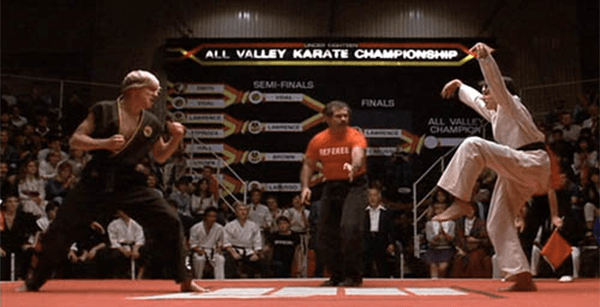 |
| Two characters positioned at the outside edges of the frame can indicate a distance between the characters. |
Subscribe to:
Posts (Atom)